Shula Goldstein's work begins with listening: to the client, to the record, and to the facts that may not be obvious at first glance.
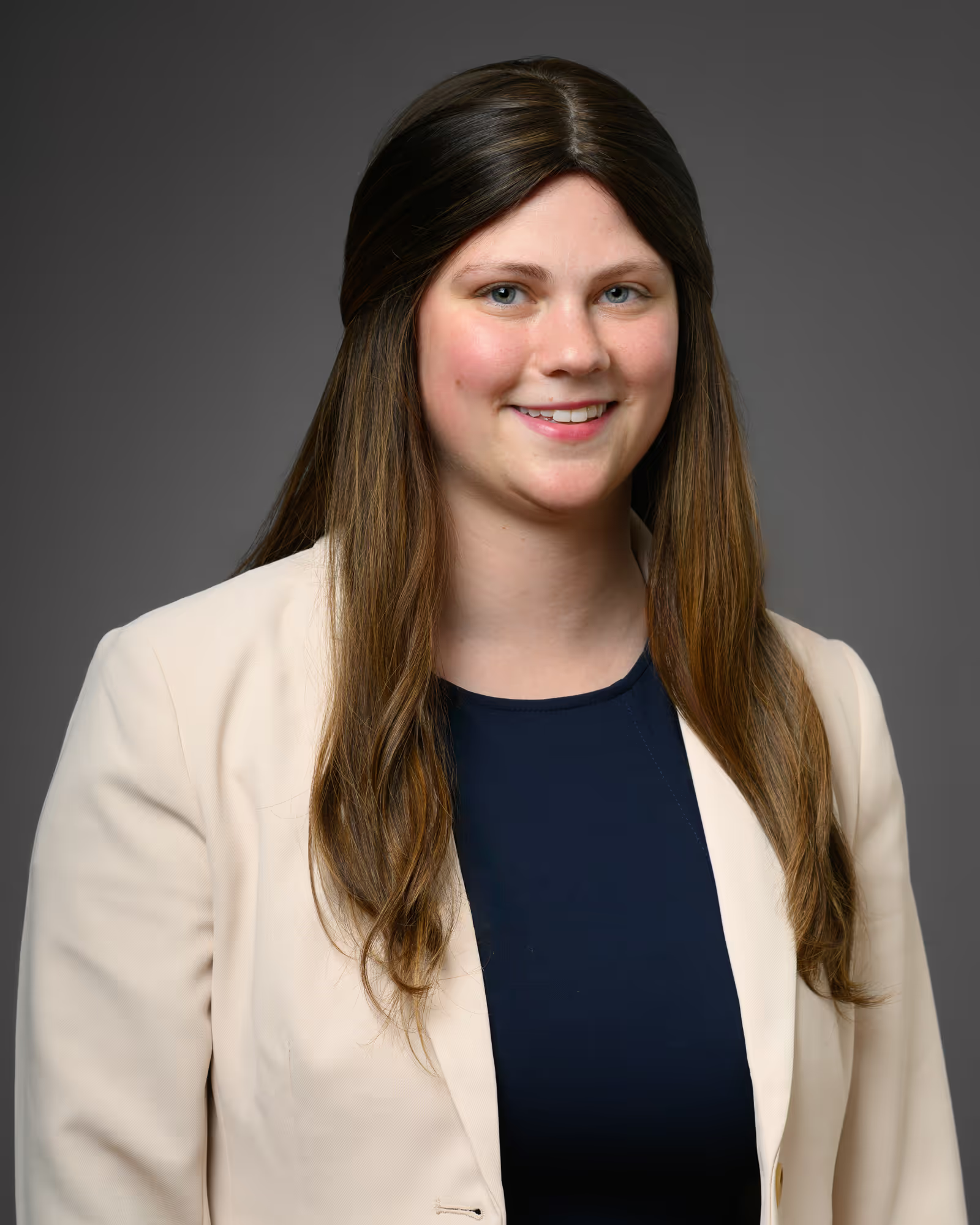
But listening is only the beginning.
Shula understands that clients do not come to a law firm simply to be heard. They come because something important is at risk. A criminal charge. A DUI/OVI allegation. A denied unemployment claim. A workplace dispute. A grievance. A disciplinary decision. A contract right that management has failed to honor.
Those problems require preparation, judgment, and the confidence to advocate when the moment calls for it.
For individual clients, Shula's work may involve criminal defense, DUI/OVI defense, unemployment appeals, employment disputes, and other legal issues that affect a person's license, job, income, reputation, or future.
For labor unions, the work is different. It may involve negotiating collective bargaining agreements, pursuing unfair labor practice charges, filing grievances, preparing for arbitration, challenging unfair discipline, and enforcing the rights workers secured through their union.
Both kinds of representation require discipline from the start: understand what happened, understand what is at stake, build the record carefully, and be prepared to press the client's position clearly.
At The Law Offices of Brian J. Smith, ltd., Shula represents clients in criminal defense, DUI/OVI defense, employment law, and labor union law. She brings strong research, analytical, and advocacy skills to each matter she handles. She is careful with clients, careful with facts, and careful with the law. She is also prepared to be direct and firm with prosecutors, opposing counsel, employers, agencies, and decision-makers when a client's rights are at stake.
Before joining the firm, Shula developed a legal foundation in civil litigation, civil rights, disability rights, client counseling, discovery, motion practice, and administrative hearings. Her work exposed her to disputes involving individual rights, access to services, institutional decision-making, and the practical barriers people face when trying to be heard by courts, agencies, employers, schools, and other large systems.
That experience shaped the way she approaches legal work.
A legal problem may first appear as a charge, a denied benefit, a workplace conflict, a disciplinary decision, a grievance, or a request for services. Behind it, there may be a person who has not been fully heard, a record that has not been fully developed, an institution that has acted too quickly, or a decision made without enough attention to the facts.
Shula's background in civil rights and disability rights reinforced the importance of developing the record with care. It also taught her that advocacy often begins before any formal argument is made. It begins in the first conversation, the first document review, and the first effort to understand what happened and why it matters.
From there, advocacy must move forward.
Shula understands that preparation has a purpose. It allows a lawyer to negotiate from a position of strength, challenge weak assumptions, respond to the other side, question witnesses, and present the client's case with clarity. Whether the matter is resolved through negotiation, hearing, arbitration, or trial, Shula prepares with the seriousness the case deserves.
Shula earned her Juris Doctor from the Benjamin N. Cardozo School of Law, where she served as a staff editor of the Cardozo Arts & Entertainment Law Journal. She spent her final year of law school as a visiting student at Case Western Reserve University School of Law in Cleveland. She also graduated cum laude from Stern College for Women at Yeshiva University with a Bachelor of Arts in Psychology.
Her background in psychology helps inform the way she works with clients. People often come to the firm during stressful, unfamiliar, and high-stakes moments. They may not know what will happen next. They may be worried about their license, their job, their benefits, their family, or the long-term consequences of a criminal accusation or workplace dispute. Union leaders may be trying to protect a member, enforce a contract, challenge unfair discipline, or preserve hard-won rights for the bargaining unit.
Shula approaches that work with care, but also with resolve.
She is attentive with clients, careful with the record, and prepared to advocate firmly when a client's rights are at stake. Her work is grounded in research, writing, preparation, and the belief that people should not be reduced to the first document written about them or the first decision made against them.
Shula is a member of the Ohio State Bar Association, the Ohio Association of Criminal Defense Lawyers, the Labor and Employment Relations Association of Northeast Ohio, the National College for DUI Defense, the DUI Defense Lawyers Association, the Cuyahoga Criminal Defense Lawyers Association, the Cleveland Metropolitan Bar Association, the West Shore Bar Association, and the Lorain County Bar Association.
For Shula, effective advocacy begins by making sure the client has been heard clearly enough for the legal issue to be understood.
Then the work becomes direct: study the facts, develop the record, understand the law, challenge the other side where necessary, and advocate for the person or union whose rights are at stake.
Shula is a member of state, local, and national organizations dedicated to criminal defense, DUI/OVI defense, and labor and employment relations.






20545 Center Ridge Road, Ste. 215, Rocky River, OH 44116
Huron, Ohio. Port Clinton, Ohio. Wickliffe, Ohio.

Please keep in mind that the success of any legal matter depends on the unique circumstances of each case and we cannot guarantee particular results for future clients based on successes we have achieved in past legal matters.
The Law Offices of Brian J. Smith, ltd. provides legal services throughout Ohio, from Cleveland to Toledo, including Sandusky, Akron, Vermilion, Huron, Elyria, Lorain, Port Clinton, Rocky River, Parma, Oak Harbor, Norwalk, Milan, Amherst, Sheffield, Avon, Oberlin, North Ridgeville, North Olmsted, Bay Village, Westlake, Cleveland Heights, Lakewood, Brook Park, Garfield Heights, Euclid, Maple Heights, Bellevue, Clyde and Berea, and within counties such as Cuyahoga, Lorain, Erie, Ottawa, Sandusky, Huron, Geauga, Lake, Ashtabula, Portage and Summit.
Copyright 2015 - 2026 Brian J. Smith, All rights reserved. ADVERTISING MATERIAL. Updated September 2026.